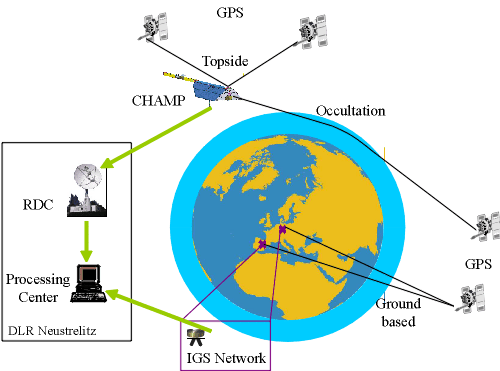
The principles of ionosphere sounding using ground and space based GPS measurements.
The Earth's ionosphere extends from about 60 km up to the bottom of the plasmasphere at about 1000 km altitude. The ionospheric behaviour is affected by numerous factors such as solar radiation (wave length < 130 nm) and solar wind, thermospheric composition and neutral winds, electric fields, particle precipitation, electric currents or mass and heat flow. On the other hand, ionospheric processes affect significantly structure and dynamics of thermosphere and plasmasphere/magnetosphere systems.
The principles of ionosphere sounding using ground and space based
GPS measurements.
Since most of the LEO satellites use topside GPS antennas for navigation and precise orbit determination, it should be mentioned that this type of measurements opens a new area in sensing the topside ionosphere and plasmasphere. Applying data assimilation techniques, the tremendous amount of data should essentially improve our knowledge about the electron density structure of the outer ionosphere on global scale.
GPS measurements onboard CHAMP are planned to be processed
automatically for retrieving ionospheric data products that will be offered
to the world-wide user community via GFZ Potsdam (CHAMP@GFZ-Potsdam).