|
links to animated TEC maps over Europe: |
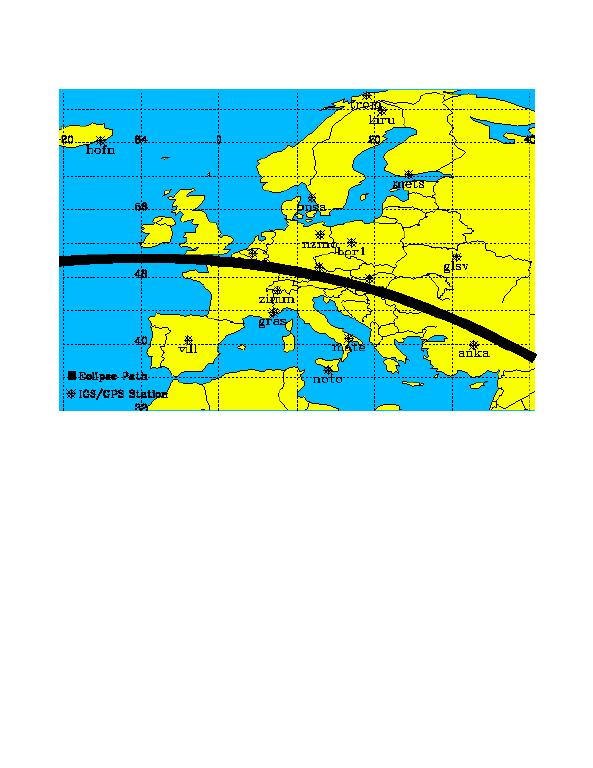
The totality zone started at 9:30 UT at the Northeast Coast of North America and moved then via Europe and Middle East to the Bay of Bengal where the eclipse ended at 12:36 UT with sunset (see Astronomical Almanac, Figure 1).
The solar eclipse offers also a good opportunity for studying ionospheric processes initiated by the well defined switch off/on of solar radiation.
The disruption of photoionisation and thermospheric heating generally leads to a reduction of the plasma density, a cooling of thermosphere and therefore also to a modification of driving forces such as winds and electric fields. Due to the supersonic speed of the Moon's shadow in the atmosphere, atmospheric gravity waves (AGW's) may be generated that would propagate upward and could be detected as travelling ionosphere disturbances (TID's) in the ionosphere region (Chimonas and Hines, 1970).
In particular the total ionisation of the ionosphere, measurable by the total electron content (TEC) is strongly affected. Today's availability of the Global Navigation Satellite Systems (GNSS) GPS and GLONASS enable regional and/or global mapping of TEC during an eclipse. Here we present the variation of the total electron content over the European and Asian area in the course of the solar eclipse on 11 August 1999 derived from GPS measurements carried out at ground stations of the International GPS Service (IGS) in the standard 30s sampling rate modus. A special tracking campaign with high rate 1Hz sampling was performed by the IGS during the 11 August and is made available to the international science community.
The measurements take advantage of the fact that GPS L-band signals on L1 and L2 frequencies propagating through the ionosphere are modified in a different way. So differential phases provide a good estimation of the integrated electron density along the ray path or slant TEC between GPS satellite and receiver.
For this study 17 GPS ground stations of the IGS network that provide high-quality 30 s standard tracking data for up to 12 satellites simultaneously were used. So TEC data from about 100 radio links are available every 30 s for constructing maps of vertical TEC. For generating horizontal TEC maps a model assisted mapping technique is applied (Jakowski, 1996) that provides a TEC accuracy of better than 3x10¹⁶ electrons/m2 and a horizontal resolution of up to about 300 km. So significant horizontal TEC structures often caused by geomagnetic/ionospheric storms can be studied (e.g. Jakowski et al.,1999).
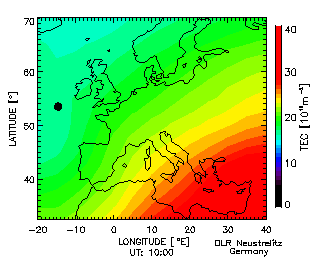
The movie (time resolution 10 min.) gives an impression of the dynamics
of the eclipse induced reduction of the total ionization that amounts to
about 40% compared with monthly averages. The location of the totality
zone is marked by a black circle. It can be stated that the ionosphere
reacts with a time delay of up to 40 minutes. The snapshot in Figure 2
shows the percentage deviations of TEC measured on the eclipse day from
27-day averaged TEC data. The delayed reduction of plasma density is significantly
reflected on the left side of the figure below.
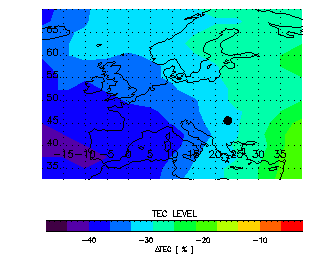 |
Figure 2 Percentage deviations of TEC obesrved on the
eclipse day from corresponding median values (previous 27 days) at 11:00 UT |
Acknowledgement:
The authors are very grateful to the IGS community for
making available high quality ground-based GPS tracking data.
References
Jakowski N., Schlüter S., Heise, S., and Feltens, J.," Satellite Technology Glimpses Ionospheric Response to Solar Eclipse", EOS, Dec 1999
Chimonas, G. and C.O. Hines, Atmospheric gravity waves induced by a solar eclipse, J. Geophys. Res., 75, 875, 1970
Jakowski, N., TEC Monitoring by Using Satellite Positioning Systems, Modern Ionospheric Science, (Eds. H.Kohl, R. Rüster, K. Schlegel), EGS, Katlenburg-Lindau, ProduServ GmbH Verlagsservice, Berlin, pp 371-390, 1996
Jakowski, N., Schlüter, S., and E. Sardon, Total electron content of the ionosphere during the geomagnetic storm on 10 January 1997, J. Atmos. Sol. Terr. Phys. 61, 299-307, 1999
The Astronomical Almanac (1999): 'The Astronomical
Almanac For The Year 1999', Washington: U.S. Government Printing Office,
London: The Stationery Office, 1999